Blog

  • Basic Credit Card Guide For Beginners

    As a beginner, you must grasp the basics of credit cards such as proper utilization and management in order to maintain financial sanity. To do this, simply go through the credit card guide below, and focus on some core points.

    Discover multiple purposes of your credit card

    Originally, the primary function of credit cards was supposed to be a tool to pay for purchases. But ever since credit cards became a global trend, you can utilize credit cards for various purposes. You can now not only  pay for items you have purchased from malls, pharmacies, groceries, restaurants, and other establishments, but also can use it for making hotel reservations and even for booking flights.

    Most service providers accept credit card payments, which means that you can pay your utility bills through credit cards. In addition, you can make online shopping easier with the aid of your credit card. Just remember that in doing so, you must arm yourself with the proper credit card guide for online purchases.

    Be aware of your spending limit              

    Most credit cards have spending or credit limits. It describes the maximum amount you can charge on your credit card. When you reach the credit limit, you cannot make further credit card charges until the limit refreshes itself. However, some issuers allow you to spend beyond your credit limit but you may have to pay for an over-the-limit fee. If you do not know what your limit is, go check with your issuer and make sure that you stick to it.

    Understand your credit card interest rate

    Everything in this credit card guide is important but the most crucial thing you should understand is your interest rate. Basically, an interest rate gives you a picture of how much it costs to use your credit card. Whenever you carry a balance on your account, it accrues a certain amount of interest over time and continues to do so until you clear your balance. Therefore, it is wiser to pay your entire bill so you can avoid interest charges.

    Expect a monthly statement of account

    Every month, the card issuer sends you a statement of account that shows all your credit card transactions, your minimum amount due, and your total amount due. Your minimum amount due tells you the required amount you have to pay to continue using your card. Your total amount due, on the other hand, is the sum of all your credit card charges for the entire billing period.

    Synopsis

    Credit cards are easy to use as you can just present it at the cashier and you are done. However, before you use your card, take some time to understand basics. This extremely basic credit card guide was designed to help new credit card users.
  • What You Need To Know About 0% APR Credit Cards

    0% APR credit cards are a very popular product with both individuals and businesses. The lure of being able to transfer balances to a zero percent annual percentage rate credit card and making most of the payment toward your principal (and not interest) is a win-win for millions of individuals who sign-up for 0 APR offers. While these balance transfer credit cards can be a great option, there are certain factors that merit closer scrutiny.

    Consider the following tips:

    There are different types of 0% APR cards

    Under the broad umbrella of 0% APR credit card offers, there are several types of cards (based on the purpose for which they are used. Some broad categories include balance transfer, cash advances, business, and purchases. Generally, the introductory interest rate will be valid for either of these categories.

    Read the terms to understand what 0% APR would apply for

    If the credit card offers 0% APR on balance transfers up to twelve months, the introductory interest rate may not apply toward traditional retail purchases or cash advances. For this purpose, read the terms carefully to understand whether the rate is valid for your routine transactions. If your sole intention is to transfer your existing balances from a high APR card to one with a 0% APR, you are in luck. Transfer your balances to the low interest rate card and try to pay off as much of your principal as possible. At least your payments won’t go toward high interest rates.

    Check on the duration of the offer

    As the cliché goes: “All good things come to an end.” The proverbial wisdom applies to credit cards as well. Generally, most 0% APR offers will be valid for only a certain duration of time — ranging from six months to up to eighteen months. As soon as that timeframe expires, your interest rates could go up significantly. Be aware of the date when the offer expires. After this duration, you may have to pay regular interest rates. The ideal situation would be to pay off all your balances before the expiration of the introductory offer.

    Lookout for transaction costs

    Some offers may have transaction costs associated with the balance transfer. Whether or not the overall transaction may be to your advantage depends on how much debt you owe. If you owe more than a thousand dollars, the transaction fee may not impair the overall value of your bargain but you must be aware of its existence nevertheless. A simple Excel spreadsheet can help you calculate the overall effectiveness of the bargain.

    If you are interested in comparing different 0% APR credit cards offers, click here. Detailed terms and conditions are provided as well.

  • How To Dispute A Credit Card Transaction

    Last year, Sam entered into a service agreement with a local company. He was promised deliverables within a span of twenty four hours, but the vendor did not live up to his end of the bargain. Sam had paid hundreds of dollars upfront. The seller refused to answer Sam’s calls and e-mails. After exhausting all resources, Sam finally requested his credit card company to intervene and at his request the payment was reversed.

    The vendor disputed the decision but because he did not have adequate documentation to prove service delivery, Sam won.

    We have all been there. If you have exhausted all resources and the seller refuses to assist you, don’t worry. There is an additional layer of protection you may be able to tap into — only if you are right and have adequate documentation to tell your side of the story.

    The technical term for filing a dispute (and requesting a refund) is known as chargeback. Chargebacks are a very powerful tool but must not be misused. If you have a history of filing repeated chargebacks, chances are that your credit company may not take your future requests seriously. If the vendor is right, he/she could end up losing more money in the form of fines, interest fees, lost transaction costs, lost service time, tarnished reputation, and other tangible and intangible losses.

    As a general rule, you must file for a chargeback only if you have genuinely been deprived of your end of the bargain.

    Here are some tips to guide you through the process of filing for a chargeback:

    Before disputing a credit card transaction, contact your merchant

    Write a letter expressing your dissatisfaction with the services/products and request the merchant to refund the money within a certain period of time. A written request can assist you when you file for a chargeback with your credit card company. In the request, provide a strict deadline for merchant to respond and make it clear that you will be pursuing the matter with your credit card company should the merchant fail to address your grievance adequately.

    Gather all documentation, contracts, receipts, e-mails, and other communications

    A little preparation could go a long way. Keep all the documentation ready before you call your credit card company. Write a letter explaining why you deserve the refund. Some credit card companies accept chargeback requests over the phone, while others may ask you to use an online grievance system.

    Once you file the request, the credit card company will notify the merchant

    As soon as the credit card company receives your request, it will notify the seller and request further information from your merchant. The seller will be given up to thirty days to dispute your chargeback request. Once all the documentation has been gathered from both parties, the credit card company will make a determination. If the credit card company rules in the merchant’s favor, you will be notified and given another opportunity to dispute the decision (Note: Some companies do not offer this second layer so make a strong case the first time itself).

    If the decision is in your favor, the funds will be restored to your account electronically.

    Please share this article with your friends on your favorite social media networks.

    If you have a story about how you filed for a chargeback, do not hesitate to share it in the comments section below.

  • Your Credit Card Type Reveals More Than You Know

    There is a much closer link between your credit card type and your personality traits. Research studies have revealed that our individual personality traits dictate color choices, vocations, mates, travel preferences, and much more.

    In recent years, there has been an increased interest in studying the link between the kind of credit card you carry and your unique personality type.

    Here are some preliminary observations:

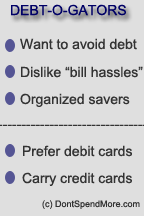
    Debdebtogagorst-O-Gators

    As a class, Debt-O-Gators include three groups of individuals: Those burnt by past credit/debt issues; individuals who dislike the hassles associated with managing credit card bills and prefer the simplicity of paying for their expenses upfront; and the organized savers who would rather save their hard-earned earnings (versus enriching large credit card companies).

    Debt-O-Gators generally prefer to use debit cards or prepaid credit cards, although they do carry one to five credit cards for occasional use.

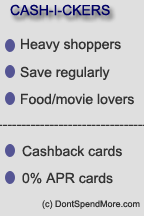
    cashickersCash-I-Ckers

    Cash-I-Ckers tend to be heavy shoppers or individuals who love the concept of saving regularly. They are also very good with numbers and can quickly crunch data to predict outcomes of their financial choices. A large proportion of Cash-I-Ckers tend to be food lovers and movie buffs. Cashback credit cards and 0% APR balance transfer cards are their favorite credit cards.

    Gallavagallavantorsntors

    Gallavantors are globe-trotting frequent travelers. To support their travel habits, they enroll in credit cards with travel reward points, airline miles, travel bonuses, discounted accommodations, and other incentives.

    Gallavantors own vacation homes, participate in timeshare programs, and engage in multiple interests.

    Horizonhorizon_gazers Gazers

    Horizon Gazers are individuals who don’t like to be tied to preset spending limits. Although they are responsible with their spending habits, they prefer to take advantage of “no cap” credit cards (credit cards that don’t have preset spending limits or offer very high credit limits to an exclusive group of applicants. Some no cap credit cards may also charge an annual fee to its members). Horizon Gazers are entrepreneurial by nature and work in senior-level positions or own businesses.

    In addition to these broad categories, some borrowers are brand conscious by nature and opt to carry big brand name credit cards. On the other hand, those loyal to their local banks sign-up for bank cards.

    Do you fall under any of these categories? What is your credit card type?

  • Top Money Mistakes Made By Unemployed Individuals

    Unannounced pink slips could jolt even the most talented professionals. The emotional roller coaster could cause even financially-savvy individuals to make money mistakes they would not have otherwise considered.

    Here are some money mistakes you must absolutely avoid:

    Ineffective budgeting (and worse, no budgeting)

    Internet surveys indicate that nearly 35% to 55% of individuals do not budget at all and a significantly larger proportion either do not adhere to their budget or adapt it to changing circumstances. Almost immediately after a layoff, take stock of all your liquid assets and create a budget that will launch you in “survival mode” for six months to a year. Trim all unnecessary expenses.

    If possible, create a temporary source of income. Blogging, temp jobs, freelancing — there are plenty of ways you can earn some extra cash without jeopardizing your job search goals.

    Not applying for unemployment insurance

    In an ad hoc survey, I found that nearly 55% of the individuals had not applied for unemployment insurance because they thought they “would not qualify for it.” Surprisingly, almost 90% of these individuals had not checked qualifications criteria with their state unemployment office.

    Unemployment insurance can be a great backup source for several months. Considering that the average job search time (US market) edges between six months to one year, a little extra help could go a long way.

    Not consulting a tax professional

    The Tax Code has several provisions that could benefit unemployed individuals. Certain expenses toward your job search may qualify for a tax break. Speak to a qualified tax expert or attorney to adjust your financial goals and tax strategies.

    Cashing out on savings before exhausting other resources

    Don’t cash out on your savings and retirement assets as soon as you hit the panic button. Your savings must be your absolute last, last [redundancy intended] resort during this time of financial crisis. Unless you are really starving, don’t touch your savings.

    Not planning effectively

    Create a roadmap for yourself describing all contingency steps you are going to take during the next three months, six months, and one year.

    Examples: If I don’t get a job within three months, I am going to share the apartment with a roommate; after six months of unemployment, I will start selling some of my furniture … get the point.

    Not mitigating risk (an unemployment account)

    If you are reading this article while you have a job, open a separate “unemployment account” where you can deposit a small percentage of your monthly earnings. The goal is to create a “cushion” that will last you several months.

    Relying on debt

    When paychecks are not certain, piling up debt is the last thing you would want to do. Avoid the temptation of using your credit card even for small expenses. If you use it, try to repay most of the principal at the end of the month. One small error here could cause a ripple effect and create headaches that will only spiral down the road.

    Not seeking professional help

    If your company has offered you outplacement assistance, take advantage of the free help. Otherwise, seek out your local Career One Stop and get help with all aspects of your job search. An average individual looks for work every four to five years. A lot changes during this timeframe. A little professional help could cut your job search time significantly.

    Most importantly, create a support group of like-minded professionals you can network with during your period of unemployment. These connections could really benefit you in many ways.

  • Credit Card Arbitrage Could Be Tricky

    In its simplest form, credit card arbitrage is a process where individuals take advantage of interest rate differentials.

    Let me explain the concept with the help of an illustration:

    John borrows $10,000 from XYZ Credit Card at 0% APR for twelve months. He transfers this money to his bank account and earns 3% on a twelve-month CD. For a period of twelve months, John will be earning 3% ($300) for literally doing nothing. His earnings could increase to double digit numbers if he were to invest these funds in opportunities generating rewards at that level. Of course, this over-simplified example ignores certain fees, costs, and risks associated with initiating an arbitrage.

    There are many self-proclaimed credit card arbitrage experts who brag about their supernatural ability to make thousands of dollars every year. While we doubt the authenticity of the numbers, theoretically it is possible to make some extra money, provided the practice is legal in your state and not prohibited by your lender’s terms and conditions.

    You may have to overcome certain barriers to get the cash advance deposited into your checking account. Some credit card companies have imposed limits and restrictions when it comes to cash advances.

    Consider the following caveats as starting points in your research about arbitrage:

    Be alert to sudden changes in interest rates

    Even if you signed-up for a 0% APR credit card, you must be extremely careful about trigger points that could spike your interest rates at a moment’s notice. If that were to ever happen, you could end up losing a lot of money. Remember, credit card arbitrage works only if the interest rate differential is substantial.

    Earnings attrition could occur at either end of the arbitrage spectrum as well. For example, your investment portfolio may also witness a sudden drop in interest rates.

    Calculate all fees associated with the transaction

    You could incur fees at various points during the arbitrage process. Cash advance fees, bank fees, and interest payments are a few examples.

    Pay your balance regularly

    To take advantage of the 0% APR, you will have to pay your minimum balance every month. Delays could trigger late fees and also cause your 0% interest rate offer to terminate prematurely. The entire balance will have to be paid off before the duration of the promotional 0% APR expires.

    Credit score will drop temporarily

    You may lose some points on your credit score as your debt to total available balance fluctuates. As you start making payments toward the principal the score will increase gradually.

    Please note: We haven’t checked into the legal aspect of arbitrage nor do we recommend or endorse credit card arbitrage. You must always check with a certified investment professional and a licensed attorney.

  • Working Capital For Business Through A Credit Card

    Running a small business could be challenging, especially if you don’t have access to capital funding from big venture capital (VC) firms or private investors. In our interaction with small business owners, most cited positive cash flows through a constant influx of working capital as their topmost priority.

    Those businesses who do not have access to VC funding have relied on either small business loans or personal credit cards as their primary source to support operational cash flow requirements. Though legally acceptable, personal credit cards suffer from a few drawbacks.

    First, they create problems when it comes to accounting and bookkeeping processes. Second, they are not designed to facilitate business transactions and hence suffer from rigid requirements when it comes to spending limits and other incentives that are otherwise available for business credit cards.

    Business credit cards offer some distinct advantage from a process perspective. The approval process is shorter, documentation requirements are not as rigid as loans, and the terms are more business friendly.

    Capital via credit cards

    Business credit cards offer a strong alternative to personal credit cards and also provide the much needed flexibility for individual business needs. Low interest rates, higher spending limits, travel points, discounts for business purchases — these are just some of the perks offered by business credit cards.

    Despite the availability of a larger spending limit, avoid relying exclusively on credit card capital as a source for running your business. The APR could severely erode your ROI and your margins in the long run. A good strategy would be balance personal funds, receivables, and capital via credit cards.

    Here are some common types of business credit cards that could be used either as a source of capital or a transactional tool:

    Cashback credit cards

    Business credit cards that offer a certain percentage cash back can be a solid tool if you make frequent purchases and are very regular with your payments. If you carry a balance, however, it may not be a good idea to opt for a cashback credit card as the APR could cost you much more than your cashback earnings.

    Travel rewards credit cards

    If your business requires you travel frequently, consider signing up for a credit card that offers travel rewards either in the form of airline miles or points that you can exchange in lieu of airline tickets.

    Higher credit limit

    If your lender offers you a higher limit, you may just solve your emergency requirements for business capital via credit cards alone. Capital credit cards.

  • Common Sense Guide To Monthly Savings

    ‘A penny saved is a penny earned’.  I am sure that all of you are well familiar with this adage. But saving money is turning out to be quite an uphill task in the current economic times. Majority of us have a huge portion of our monthly earnings deducted to pay for loan EMIs, credit card bill payments, utility bill payments etc, even before we can touch any of it.

    But you might have read another popular quote that says ‘Where there is a will, there is a way’, right? So here it is- the common sense guide to monthly savings to help all of us ‘save for a rainy day’

    Let’s start at the beginning

    Irrespective of whether we belong to the category of people who ‘eat to live’, or ‘live to eat’, one thing is certain. Our lives are intricately related to eating. So why not find out some common sense ways to save money on our food expenses each month?

    Most of the people who work usually depend on takeaways, especially for their lunch and quite often for their dinners as well. But maybe it’s time to change this habit because a certain report published in The Telegraph (UK) says that ditching the takeaway just once in a week can save up to $1,300 per year. Not bad, especially when you need to sacrifice just 1 takeaway per week or 4 for the month.

    Beware! Shopping can be addictive

    A huge part of the necessities in our lives needs to be paid for and obviously you gotta shop for things you need to buy. But have you taken a close look at your shopping bills lately? Okay, I suggest that you do this fun exercise today.

    Check your credit card statements for the past 3 months and see if you can separate the dire necessities from the extravagances. I am sure that you would be surprised at what you see at the end of your fun exercise. Don’t the extravagances seem to dominate a little over the necessities?  Well, there’s nothing to panic yet.

    Next time you go out shopping, make sure you have a list with you. Once you are done with creating the list, mark the urgent necessities, necessities that can wait and extravagances in different colors. When you finally start shopping, ignore the last 2 categories and just shop for the urgent necessities. Do this every time you shop and you will see at least a 30 % savings on your monthly credit card bill.

    Carpooling can be cool

    Yeah, I know how that sounds at first impression, but believe me when I say that you could save a whole lot of dollars each month if you decide to carpool. It goes without saying that if your whole family (working spouse and children) decides to carpool, then you will surely return back next month to thank me profusely via the comment section. Oh! You’re welcome (in advance).

  • Factors Impacting Your Car Insurance Rate

    You know, car insurance can be a tricky thing. Yeah I said tricky, but if you were me, you would be using the term ‘weird’ to describe how car insurance rates are worked out. Well, you tell me a better word than weird, when you realize how seemingly unrelated stuff like where you live may actually influence the amount of money you need to shell out towards car insurance premium each month. See, I warned you!

    What is your address?

    If you live in a city that has more cars then you pay more premium rates. Well, the logic applied is that more the cars per square mile more are the chances of accidents. If you don’t like it, go live in some rural area.

    Okay let us talk about some more, weirder things that can influence your car insurance rates.

    How Much Does Your Doctor Charge You?

    A lot depends upon how much your doctor charges you to treat for injuries received as a consequence of a vehicular accident. Often a blanket term like ‘soft tissue injuries’ is used to describe the group of injuries, that are commonly inflicted in a vehicular accident

    Treating these injuries can be expensive and often extend over longer periods of time. Moreover, the results of the treatment are also not quite comparable. Some patients recover better and sooner from these injuries, while others can really drag on for long periods. All these put a strain on the insurance company and they obviously do not want to be left high and dry paying for such claims.

    So bottom line is that more expensive your medical care, more expensive will be your car insurance premium.

    How much does the lawyer charge?

    Okay, the relation between medical costs and insurance premium now seems to somehow fall into place, but what’s a lawyer’s fees got to do with your insurance rates. Isn’t it what you are thinking? Well, each time someone who is at the receiving end of a vehicular accident that you made, files a lawsuit claiming for compensation, it’s your insurance company that has to dole out dollars / pounds as the case may be.

    Besides, the numbers of lawsuits being filed in vehicular accidents are steadily on the rise. So, it’s but natural for your insurance company to save their back and foresee these costs. Guess who has to pay more towards premium then?

    How many fraudsters are doing successful business?

    Whoa, whoa! Now fraudsters have got a say in your car insurance rates too? Well, someone has to pay for the huge amounts of money that fraud insurance claims are draining out of the insurance company’s accounts. Who else fits the bill, better than you? More the number of fraud claims, more expensive will be your premium.

    How cutting-edge is your car?

    If you are the kind of person who melts like butter on seeing the latest models of cars with latest technological and design advancements, then you better be prepared to pay more for your insurance premium as well. You know, car mechanics don’t come cheap and more advanced the car parts, more expensive they are to replace in case of repair / damage.

    Moral of the Story: If you wanna lower your car insurance rates, go live in some rural dump where the doctor charges quite less and the lawyers don’t suck your blood for fees and drive a not-so-latest model car.

  • Easy Budgeting Strategies

    I don’t know about you, but when my best friend hears the word budgeting, all she can think of is cutting back on dire necessities. Don’t ask me, because I really don’t know where she conjures up weird ideas of going without meals whenever I mention budgeting to her.

    I really hope none of you folks have a dangerous imagination like my dear friend, because I am gonna show you some easy budgeting strategies that definitely does not involve anyone going without 3 full meals a day.

    Have a budget plan

    I know it seems to be the most boring task on the face of Earth, but you really gotta do this folks. Sit down with a paper and pencil and preferably with someone who shares your budget like your spouse or partner.

    Make a list of all the things that you need to spend money on for the entire month. Don’t forget to add any expense at this point, even if it seems quite trifle to you.

    Categorize your expenses

    Take a close look and separate the dire necessities from the luxuries and extravagancies. No, don’t be tempted to push ‘shopping for your 18th pair of shoes’ to your dire necessities category. What? I am just saying, that’s all, no ill feelings!

    Okay by the time you are finished you should have a pretty good demarcation between the 3 categories of stuff. You will find that the majority of the dire necessities category is taken up by items like paying your rent / home loan EMI, car loan EMI, credit card bill payment, utilities bill payment etc. But that is expected.

    Time to check your expenditure pattern

    Now take a look at the other 2 categories. Now is the time when you need to refer to your credit card statements for the past 12 months. Is there a pattern emerging? Do you find yourself spending hundreds of dollars each month on clothes/ accessories or stuff like that?

    Majority of the individuals, who analyze their credit card statements in this way, usually agree that they have had a major ‘revelation’. Cut back on the unnecessary expenses and if you cannot do it entirely, consider increasing the time duration between 2 such shopping sprees. Like for example, if you have a habit of buying clothes every month, try reducing such sprees to just 6 per year and from then to just 3 per year. Timing these shopping sprees to coincide with festival discount offers and clearance sales is another great way to easy budgeting.

    Start a new way to earn money each month

    Getting a secondary source of income is a great idea, but that is not what I actually mean here. Have you ever considered paying yourself some money each month? Yeah, people call it by many other names like savings, investments etc, but I prefer calling it this way (it makes you want to do it at all costs)

    Fix a certain amount of money that you need to pay yourself and make sure that you include it under the dire necessities category. Do what it takes to squeeze this money out of your monthly budget each month and that includes cutting back on entertainment, dining out less frequently or walking to work.

    If you stick to all the easy budgeting strategies this month and then discipline yourself to repeat the success every month of the year after that, you will soon become a pro at budgeting!