Category: Your Safety

  • Cell Phone Fraud Prevention Strategies

    By Dr. Kavita

    It is not a pleasant situation when you are at the receiving end of a fraud. With growing technological advancements, criminals are also polishing and fine tuning their skills and developing matching ideas and plans to perpetuate devastating scams, including cell phone fraud. In simple words it means that you need to be more alert than ever to save yourself from falling in to a fraudster’s trap nowadays.

    Click here to compare cell phone plans — free phones with select offers

    Cell phone fraud has become quite common. You might have already experienced one yourself or at least someone among your near and dear ones or acquaintances have recounted experiences relating to such scams. But contrary to popular belief, protecting yourself from such adversities can be done by ensuring a few simple steps as follows:

    Keep your phone locked

    Just because no one else uses your cell phone or no one else has access to your cell phone, does not mean that you should leave it unlocked at all times. Every cell phone has a system built in to enable locking it and preventing unauthorized access. Make use of this facility and use a strong password that no one will be able to guess.

    Be wary of using free Wi-Fi

    Free is not always safe; so keep that in mind when enjoying free access to the internet at WiFi hotspots. Cyber criminals are not your run-of-the-mill criminals. So don’t picturize them as high school dropouts or uneducated people. They could be very sophisticated when it comes to technology and this updated knowledge puts them in  a position to hack even the most robust cyber protection system.

    Using free WiFi at hotspots are an open invitation for cyber criminals to trap you in their fraud plans. Consider installing safety mechanisms to prevent cell phone fraud at public hotspots.

    Don’t go crazy over apps

    Nowadays people are going crazy downloading apps of all sorts. Majority of us like to download the latest app, with little regard to the security issues that it may pose. Do not go overboard with apps as they are the most common route by which fraudsters gain access to your cell phone. Make sure you evaluate security certificates and tech reviews before downloading any app for your phone.

    In case of theft, take quick action

    Whenever your cell phone gets stolen or lost, make sure that you intimate your wireless provider without any delay. This ensures that the cell phone either gets locked down and prevents further access to sensitive details stored on your phone. Some wireless providers may also offer remote access clean up services as well. Your cell phone can be wiped clean of all the data stored within it by using remote access.

    Never be careless while conducting financial transactions

    Financial transactions must be conducted with a lot of care on your cell phone. Never ever save the bank passwords on the phone and also remember to logout of the bank website after your transaction is over. Exercise similar caution when paying online using credit cards or PayPal accounts.

    Simple steps like these will go a long way toward ensuring protection from the most common cell phone frauds. Be safe!

    Click here to compare cell phone plans — free phones with select offers
  • Save Money By Reducing Your Vulnerability

    By John

    In these challenging times, most people are either choosing or having to make serious choices about their spending habits in order to save money. The most-touted choices inevitably entail a certain amount of pain or sacrifice; however there is one approach to saving money that is not so often mentioned, yet is relatively painless. With rising levels of crimes of ‘economic desperation’, both here at home and in many of our overseas vacation destinations, safe-guarding what is ours can save a considerable amount of expense and hassle in the short- and longer-term.

    Click here to compare offers and save money

    How am I vulnerable?

    Apart from assets you may hold in the bank and safety deposit boxes, your valuable possessions are pretty much held in your house or on your person.

    Your vulnerability can cost you heavily

    Having something stolen from you, especially violently, can cause you considerable expense. There may have been damage to your property, you may need medical attention and, of course, there are the replacement costs of the items stolen. If you make an insurance claim you may recoup some of the loss but your credit rating is likely to take a hit.

    What you can do to improve your residential security

    No matter how much you spend on a security system, it won’t guarantee your house to be burglar-proof against the really determined burglar: remember, what man has put together, man can take apart. Whether you have a security system or not, here are some basic common-sense rules:

    • All doors and windows should be lockable and locked. The quality of the locks used should be standard throughout i.e. the same quality for the garage door and cat-flap as for the front door or gate.
    • The outside of your house should be adequately lit at night. A timer switch will ensure the lights are switched on when you are away. Good lighting and robust locks may be enough to deter an opportunistic burglar, or at least delay him until help arrives.
    • Don’t advertise the fact unnecessarily that you may be going away on a trip or vacation. Neighbors may be amenable to keeping an eye on your house if you are away.
    • Be rigorous about authenticating the ID of anybody you don’t know who asks to enter your house, for whatever reason. Reputable organizations make this easy for you.
    • Be suspicious about people loitering near your house.
    • Make sure you have a reliable means of calling the police to your house if necessary.

    What you can do to improve your personal security

    Your best weapon against being mugged or robbed on the street or in a public place is ‘situational awareness’. If something doesn’t look right to you, it probably isn’t. But you won’t be aware of it if you are listening to music on your earbuds and texting at the same time. Paying attention to your surroundings takes discipline and effort. In addition an alert-looking person is less likely to be attacked by a mugger than one looking as if he is in a trance.

    Here are some practical tips to reduce your personal vulnerability:

    • Don’t wear all your flashiest accessories on the street.
    • Don’t carry more cash and cards around than you might reasonably be expecting to use.
    • Keep your wallet/purse in a fastened pocket, preferably an inner one.
    • Consider carrying a ‘throwaway’ wallet containing only a little cash with your main wallet better secured inside your clothing.
    • Use an ATM inside a bank lobby or in a building with security staff present, rather than one on the street.
    • Be alert when exiting a bank; secure any cash you may have withdrawn before you leave the building.
    • Consider running a bank account with only a small balance that you use for daily expenses and top up frequently. That way your exposure to loss is limited if the card linked to that account is compromised.
    • Particularly when overseas, carry photocopies of important documents in your wallet and leave the originals in a safe place. Better to have a slight problem with the police than have to obtain a passport at short notice.

    It’s all about exposure…….

    The better you protect what is yours, the less you expose yourself to the risk of being vulnerable and having someone try to take it away from you. Following these simple tips will save you money if the worst should happen.

    Click here to save hundreds of dollars every month

  • How To Get Health Insurance If You Don’t Have a Job

    Most of us cannot even imagine how our lives would be if we did not have our health insurance to cover us. But there are people who do not have a job in the first place and are living highly insecure lives. Or there are instances where people enjoy health cover with their current jobs, but are suddenly faced with a situation where they lose both their job and insurance

    These situations seem too scary to even think about, but health is not something that can be ignored. There has to be some way in which people can enjoy health insurance coverage even if you don’t have a job.

    Health insurance after leaving/losing your previous job

    Many employed individuals (especially those over the age of thirty) cannot afford to pay the health insurance premiums after losing their jobs. There is a provision of the law that goes by the acronym COBRA (Consolidated Omnibus Budget Reconciliation Act) which was passed in 1986 to facilitate continuation of group health insurance coverage to former employees.

    COBRA extends coverage to certain former employees and retirees and spouses, former spouses, and dependent children of both these retirees and former employees. The major criteria here is that the services of the employee must not have been terminated due to gross misconduct.

    COBRA is commonly applicable only to private-sector employers that have employed twenty or more employees, employee organizations, or state and local governments. The coverage is generally extended only up to eighteen months after losing the job/voluntary retirement, but can be prolonged to thirty six months in special cases, where there is another qualifying event during the first eighteen months.

    Other low cost choices

    Many people are out of jobs at the moment but are trying to get one at the earliest. They only need a temporary coverage for the time period in between the previous and the next job. There are many companies that cater to the requirements of such individuals. The coverage offered is usually for a year and may not cover any of your preexisting health conditions.

    Individual health plans for those who can afford

    If you can manage to pay $1,000 or more per month for family health insurance, provided all of you are comparatively healthy, then you can consider an individual health insurance plan. You have to take into account any chronic disorders like diabetes or cancer, which could pose a problem in getting coverage.

    But if you are fortunate enough to live in one of the five states where health insurance premiums are determined by regulators, then you cannot be refused health coverage.

    But for the less fortunate ones who live elsewhere, the coverage offered by your health insurance entirely depends on the state and their rulings regarding the preexisting health conditions. Most of the time, there may be a blanket health insurance cover denial for preexisting conditions.

    Other options

    If you are a member of a certain association or group with a large number of members, you may be able to take advantage of group rates negotiated by the entity. Furthermore, there are non-profit organizations and other institutions that focus on helping people obtain the right coverage. Some hospitals have special plans for low income individuals. You may want to explore government programs as well.

    No matter what option you choose, you must try your best to obtain health insurance coverage for you and your family.

  • Cell Phone Radiation: Easy Ways To Protect Yourself

    Technology has drastically improved our lifestyles, and by drastically I mean a lot of areas in our life are impacted. There is no doubt that we have seen a dramatic improvement in the way we cook, the way we travel, the way we build our homes and the way we communicate.

    Speaking of communication, technology has made it possible to interact with any one, at any place on this Blue Planet. But such improvements are often packaged with some far-reaching and undesirable effects on human health. One such issue is that of cell phone radiation.

    Cell phone radiation and conflicting theories

    As surprising as it may sound, cell phone radiation has been a major source of contention. While some research findings claim that the radiation emitted by cell phones is too low and hence inadequate to create any deleterious effect on health, there are as many contrasting reports that are crying hoarse about the dangers to human health. Thus far all we can say is that the findings appear to be contradictory.

    Cell phone radiation dangers to human health

    There are a variety of health disorders that are being linked to cell phone radiation, but the most important and notable one amongst them is the increased risk of developing brain cancer/tumor. The radiation emitted from the cell phones is likened to that emitted from a microwave oven and the heat released from the cell phones during usage is said to slowly cook the brain and destroy the brain cells.

    These side effects are said to occur more in people who engage in prolonged and continued cell phone usage. Other health effects include loss of memory. All this has been debated but there is scientific merit on both sides.

    How to protect yourself from cell phone radiation?

    The simplest answer would be to completely avoid using any cell phones at all, but that is far from being practical. The most practical solution is to limit the duration of usage of your cell phone to the bare minimum.

    The next method that is commonly recommended by experts is to make use of text messaging instead of voice call, whenever you can. This method will definitely reduce your monthly phone charges as well (if that is any motivation for you to avoid cell phone radiation).

    Experts who have been doing research on this topic have found that the cell phones tend to emit maximum amounts of radiation when their batteries are under charged. So, make it a point to re-charge your battery before it touches base level and also avoid using your phone if you find that the charge is very low.

    Using wired headsets and switching the speaker option on, are both two easy steps towards protecting your body from unnecessary radiations.

    Another method known as the toggle method, which entails holding the phone away from your body while speaking and closer to the ear only for hearing, is also an useful method, but not necessarily convenient and acceptable to everyone.

    Different cell phones have found to emit different levels of radiation. People who are quite serious about avoiding cell phone radiation can opt to buy only those models that emit the lowest levels of radiations. FCC may have more to say on that, though.

  • Is A Fake Friend Lurking Around In Your Social Network?

    fake_friend_alert

    I love being a netpreneur. Running an online business has allowed me to explore areas I would have never considered if I had not been in this business. Then there is the other side: I come across scams and fraudulent online marketing schemes that thrive on [misplaced] trust. I am not talking about the famous “e-mail me your routing number” or “date me abroad” types. Those were perhaps at the kindergarten level in the world of sophisticated scams — maybe a training school for rookie Internet scammers.

    Here, I am talking about live human viruses that may be lurking around in your social networks already. These could be individuals who have already gained your trust and are masquerading as your friends and well-wishers. From game invites to roses and funny one-liners, they adopt a wide range of strategies to gain your trust and indirectly seek your blessings to crawl their way into your friends’ networks, often at the cost of the reputation and trust you enjoy with them.

    100_million_people

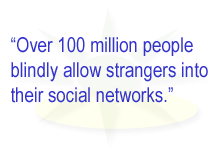
    Unfortunately, these operations are so subtle and difficult to spot that even the savviest of social media users fall prey to some very damaging machinations. Worse, over 100 million people blindly allow strangers into their networks. Before getting into the basics about protecting yourself, you should become familiar with how these fake friends manage to get into your network in the first place.

    One friend innocently opens the mythical “Pandora’s Box” and lets the flies loose

    The operation invariably starts with a fake account (human or a bot). It is not that hard to get one. All you need is a valid e-mail address and voila you have your passport to officially eavesdrop on millions of social media conversations.

    At the next level, the fake account makes a concerted effort to join groups, fan clubs, community and interest-themed pages, celebrity hangouts, large brands, and other areas where it is easy to connect with a large number of people. Furthermore, having a common interest makes it easy for these individuals to make more friends and initiate conversations without giving away their true intentions.

    Once this background is setup (or simultaneously), the fake account starts connecting with individuals randomly or in a targeted fashion. Once they make a friend, they will slowly start sending friend requests to that individual’s network and make their way through a Web of people, often mimicking search engine robots in the process. It is not that hard to accept a request from a friend’s friend, right? You may be surprised but over ninety percent of individuals will accept a friend request if it comes from a friend’s friend. Social manners!

    So, what do they do with all these connections?

    A lot more than you know. At a very basic level, they could use their relationship with you to gather more “likes” or ask you or your friends to click on questionable websites and send traffic their way. Often, this viral traffic is sold or auctioned off for a profit — without your informed consent. If you receive “$5 for 1,000 friends” spam you know what I am talking about.

    What else could they do? A lot. Even if your privacy settings are very secure, your friends will still be privy to the information you post and share. Just by evaluating your social media habits they could paint your profile, spy on you, find your address, and do so much more damage.

    Some genuinely good people see the world as being a mirror image of their own personality. They share pictures of “first paychecks,” “first credit card approvals” and even children’s information. That is a lot of ammunition for unscrupulous con artists. Seriously, just zoom the check’s image and you have the routing number, account number, and so much more. Great! Shopping spree! Let’s ship the goods to another continent.

    You may have come across news stories of how houses were burglarized because the homeowner posted the family status as being at “XYZ Place” (hundred miles away from home). Perfect timing. We have two hours to swipe the house squeaky clean.

    How to spot a fake friend

    You could use various strategies to spot a fake friend but being vigilant to your friends’ activities is perhaps the best way to gauge their intentions. Some common threads I have discovered include:

    Huge disproportion between number of friends and other activities. This morning one of my business pages received a like from someone who had two friends and nearly 1,800 likes. Tells a story? Seriously, if you want to fake it, do it the right way. I removed him immediately. Always review your potential friend’s activity to understand what he/she is into.

    Picture-perfect models. More often than not, they will use images of picture-perfect models to either hide their nationality or give you the impression that a legitimate Greek god or goddess is interested in your friendship.

    The win-your-trust strategy. If you just posted information about a personal tragedy or an emotional roller-coaster, this is the perfect timing for them to win your trust. Be wary of strangers wanting to empathize with you.

    An unreasonably large number of photo tags. We all tag pictures but if you see a super-high number of tags, be careful.

    Super-human profile. Wide range of interests, 400-pound bench pressing skills, extra-benevolent personality … chances are the fake friend will try to charm or flirt his/her way to your friendship.

    Insufficient personal activity. If you see very few personal pictures and a large number of places or things, be alert. Red flag.

    Of course, all of these could be manipulated to give you the impression that the person is real, but common sense and some basic research (Google!) should help you spot the fake. Nothing wrong in being open to friendships. Just a little discretion could go a long way toward safeguarding your own safety.