Category: Credit Cards

  • How To Dispute A Credit Card Transaction

    Last year, Sam entered into a service agreement with a local company. He was promised deliverables within a span of twenty four hours, but the vendor did not live up to his end of the bargain. Sam had paid hundreds of dollars upfront. The seller refused to answer Sam’s calls and e-mails. After exhausting all resources, Sam finally requested his credit card company to intervene and at his request the payment was reversed.

    The vendor disputed the decision but because he did not have adequate documentation to prove service delivery, Sam won.

    We have all been there. If you have exhausted all resources and the seller refuses to assist you, don’t worry. There is an additional layer of protection you may be able to tap into — only if you are right and have adequate documentation to tell your side of the story.

    The technical term for filing a dispute (and requesting a refund) is known as chargeback. Chargebacks are a very powerful tool but must not be misused. If you have a history of filing repeated chargebacks, chances are that your credit company may not take your future requests seriously. If the vendor is right, he/she could end up losing more money in the form of fines, interest fees, lost transaction costs, lost service time, tarnished reputation, and other tangible and intangible losses.

    As a general rule, you must file for a chargeback only if you have genuinely been deprived of your end of the bargain.

    Here are some tips to guide you through the process of filing for a chargeback:

    Before disputing a credit card transaction, contact your merchant

    Write a letter expressing your dissatisfaction with the services/products and request the merchant to refund the money within a certain period of time. A written request can assist you when you file for a chargeback with your credit card company. In the request, provide a strict deadline for merchant to respond and make it clear that you will be pursuing the matter with your credit card company should the merchant fail to address your grievance adequately.

    Gather all documentation, contracts, receipts, e-mails, and other communications

    A little preparation could go a long way. Keep all the documentation ready before you call your credit card company. Write a letter explaining why you deserve the refund. Some credit card companies accept chargeback requests over the phone, while others may ask you to use an online grievance system.

    Once you file the request, the credit card company will notify the merchant

    As soon as the credit card company receives your request, it will notify the seller and request further information from your merchant. The seller will be given up to thirty days to dispute your chargeback request. Once all the documentation has been gathered from both parties, the credit card company will make a determination. If the credit card company rules in the merchant’s favor, you will be notified and given another opportunity to dispute the decision (Note: Some companies do not offer this second layer so make a strong case the first time itself).

    If the decision is in your favor, the funds will be restored to your account electronically.

    Please share this article with your friends on your favorite social media networks.

    If you have a story about how you filed for a chargeback, do not hesitate to share it in the comments section below.

  • Your Credit Card Type Reveals More Than You Know

    There is a much closer link between your credit card type and your personality traits. Research studies have revealed that our individual personality traits dictate color choices, vocations, mates, travel preferences, and much more.

    In recent years, there has been an increased interest in studying the link between the kind of credit card you carry and your unique personality type.

    Here are some preliminary observations:

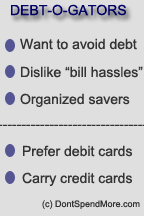
    Debdebtogagorst-O-Gators

    As a class, Debt-O-Gators include three groups of individuals: Those burnt by past credit/debt issues; individuals who dislike the hassles associated with managing credit card bills and prefer the simplicity of paying for their expenses upfront; and the organized savers who would rather save their hard-earned earnings (versus enriching large credit card companies).

    Debt-O-Gators generally prefer to use debit cards or prepaid credit cards, although they do carry one to five credit cards for occasional use.

    cashickersCash-I-Ckers

    Cash-I-Ckers tend to be heavy shoppers or individuals who love the concept of saving regularly. They are also very good with numbers and can quickly crunch data to predict outcomes of their financial choices. A large proportion of Cash-I-Ckers tend to be food lovers and movie buffs. Cashback credit cards and 0% APR balance transfer cards are their favorite credit cards.

    Gallavagallavantorsntors

    Gallavantors are globe-trotting frequent travelers. To support their travel habits, they enroll in credit cards with travel reward points, airline miles, travel bonuses, discounted accommodations, and other incentives.

    Gallavantors own vacation homes, participate in timeshare programs, and engage in multiple interests.

    Horizonhorizon_gazers Gazers

    Horizon Gazers are individuals who don’t like to be tied to preset spending limits. Although they are responsible with their spending habits, they prefer to take advantage of “no cap” credit cards (credit cards that don’t have preset spending limits or offer very high credit limits to an exclusive group of applicants. Some no cap credit cards may also charge an annual fee to its members). Horizon Gazers are entrepreneurial by nature and work in senior-level positions or own businesses.

    In addition to these broad categories, some borrowers are brand conscious by nature and opt to carry big brand name credit cards. On the other hand, those loyal to their local banks sign-up for bank cards.

    Do you fall under any of these categories? What is your credit card type?

  • Credit Card Arbitrage Could Be Tricky

    In its simplest form, credit card arbitrage is a process where individuals take advantage of interest rate differentials.

    Let me explain the concept with the help of an illustration:

    John borrows $10,000 from XYZ Credit Card at 0% APR for twelve months. He transfers this money to his bank account and earns 3% on a twelve-month CD. For a period of twelve months, John will be earning 3% ($300) for literally doing nothing. His earnings could increase to double digit numbers if he were to invest these funds in opportunities generating rewards at that level. Of course, this over-simplified example ignores certain fees, costs, and risks associated with initiating an arbitrage.

    There are many self-proclaimed credit card arbitrage experts who brag about their supernatural ability to make thousands of dollars every year. While we doubt the authenticity of the numbers, theoretically it is possible to make some extra money, provided the practice is legal in your state and not prohibited by your lender’s terms and conditions.

    You may have to overcome certain barriers to get the cash advance deposited into your checking account. Some credit card companies have imposed limits and restrictions when it comes to cash advances.

    Consider the following caveats as starting points in your research about arbitrage:

    Be alert to sudden changes in interest rates

    Even if you signed-up for a 0% APR credit card, you must be extremely careful about trigger points that could spike your interest rates at a moment’s notice. If that were to ever happen, you could end up losing a lot of money. Remember, credit card arbitrage works only if the interest rate differential is substantial.

    Earnings attrition could occur at either end of the arbitrage spectrum as well. For example, your investment portfolio may also witness a sudden drop in interest rates.

    Calculate all fees associated with the transaction

    You could incur fees at various points during the arbitrage process. Cash advance fees, bank fees, and interest payments are a few examples.

    Pay your balance regularly

    To take advantage of the 0% APR, you will have to pay your minimum balance every month. Delays could trigger late fees and also cause your 0% interest rate offer to terminate prematurely. The entire balance will have to be paid off before the duration of the promotional 0% APR expires.

    Credit score will drop temporarily

    You may lose some points on your credit score as your debt to total available balance fluctuates. As you start making payments toward the principal the score will increase gradually.

    Please note: We haven’t checked into the legal aspect of arbitrage nor do we recommend or endorse credit card arbitrage. You must always check with a certified investment professional and a licensed attorney.

  • Working Capital For Business Through A Credit Card

    Running a small business could be challenging, especially if you don’t have access to capital funding from big venture capital (VC) firms or private investors. In our interaction with small business owners, most cited positive cash flows through a constant influx of working capital as their topmost priority.

    Those businesses who do not have access to VC funding have relied on either small business loans or personal credit cards as their primary source to support operational cash flow requirements. Though legally acceptable, personal credit cards suffer from a few drawbacks.

    First, they create problems when it comes to accounting and bookkeeping processes. Second, they are not designed to facilitate business transactions and hence suffer from rigid requirements when it comes to spending limits and other incentives that are otherwise available for business credit cards.

    Business credit cards offer some distinct advantage from a process perspective. The approval process is shorter, documentation requirements are not as rigid as loans, and the terms are more business friendly.

    Capital via credit cards

    Business credit cards offer a strong alternative to personal credit cards and also provide the much needed flexibility for individual business needs. Low interest rates, higher spending limits, travel points, discounts for business purchases — these are just some of the perks offered by business credit cards.

    Despite the availability of a larger spending limit, avoid relying exclusively on credit card capital as a source for running your business. The APR could severely erode your ROI and your margins in the long run. A good strategy would be balance personal funds, receivables, and capital via credit cards.

    Here are some common types of business credit cards that could be used either as a source of capital or a transactional tool:

    Cashback credit cards

    Business credit cards that offer a certain percentage cash back can be a solid tool if you make frequent purchases and are very regular with your payments. If you carry a balance, however, it may not be a good idea to opt for a cashback credit card as the APR could cost you much more than your cashback earnings.

    Travel rewards credit cards

    If your business requires you travel frequently, consider signing up for a credit card that offers travel rewards either in the form of airline miles or points that you can exchange in lieu of airline tickets.

    Higher credit limit

    If your lender offers you a higher limit, you may just solve your emergency requirements for business capital via credit cards alone. Capital credit cards.

  • Credit Card Secrets You May Not Know

    It is quite tough to agree that you do not know of any secrets about credit cards. You have been using plastic money ever since you can remember (for most part of it) and now there’s nothing you do not know about it, right? Well, if you ask me I think it’s a bit too early to say that. At least not until you have read through this article to the last word. So, you ready to move forward to reading this post? Yeah, I thought so.

    Paying balances first is prudent

    Majority of us credit card users already are aware of the dangers of availing a cash advance on our cards. But probably very few of us know a secret about cash advances. The credit card company will always give first priority and preference to standard purchases.

    So no matter how quickly you may have paid off the cash advance that you availed on your credit card in a desperate attempt to get rid of the cut throat interest rates, you will never succeed in freeing yourself from its claws if you carry a balance.

    So this means that your cash advance will continue to be considered as unpaid debt until you pay off the outstanding balance on your credit card purchases. And need I remind you that cash advances are charged up to 29.99 % interest until they get paid off in total?

    It is tough to keep a secret from your credit card company

    Have you read your credit card agreement in full detail? I doubt it; because I am sure you have not yet read about the Universal Default Clause yet. What this means in layman terms is that your credit card company has the right to hike the interest rates applied to your credit card, at any given point of time, if they get wind of your financial secrets (at least you thought that it was a secret).

    What is this secret? If you have defaulted on payments of any of your loans like auto loan, home loan or personal loan (from banks which have no relation whatsoever with your credit card provider), your credit card company will find this out and will automatically brand you as a ‘high risk’ customer. And you know that ‘high risk’ is not a pretty label to carry around in the credit card industry. No matter how old your account with the credit card company is, you are suddenly thrown down from the pedestal of ‘loyal customer’ to a deplorable ‘high risk’ category.

    Your creditors’ address could affect your interest rates

    Have you ever imagined that the address where your credit card company is located can influence the interest rates that they charge you for providing service? Well, there are States like Delaware and Utah have no cap on the interest rates that credit card companies are permitted to charge. Blame it all on weak Usury laws, but if your credit card company is incorporated in States which have no cap on the interest rates, then they could charge you through the roof or hike their current rates of interest without breaking any law.

    Didn’t I say that I knew of 3 secrets you never knew about credit cards?

  • Amazing Ways To Improve Your Credit Score

    A sagging credit score usually has a similar effect on your mental peace and ego. By the way, you are not alone in the world, fumbling in the dark with low credit scores. Approximately 14.25 % of the US population has credit scores ranging somewhere between 300 and 549. But guess what, this actually is great news. You want to know how?

    FICO statistics reveal that around 1.4 million people have found ways to improve their credit scores from the previous year. Now that’s good news, isn’t it? The best part is that you too can use some of the amazing ways used by those 1.4 million people, to improve your credit score. Get ready to know how they did it.

    Add a loan EMI to your Report

    When you leave evidence on your credit reports that you are paying loan installments, you are actually displaying proof of your capability to take on a financial responsibility.   This is by far the speediest way to improve your credit scores.

    In case you do not have any loans as of now, maybe taking a small personal loan that allows you to make regular installments to pay it back will suffice.

    Trim your balances

    Credit scores are influenced a great deal by the balance amount that flashes in your previous month’s credit card statement. You need to find ways to reduce and trim down the outstanding balances each month.

    You can also try to set up a reminder to pay the dues each month before the end of the due date. Try limiting the usage to just 10-30 % of the total credit available each month. Or you could try to convince the credit card company to send you a reminder when you overshoot 10-30 % of your credit limit for each month.

    Pay off some balance

    When you pay off some of the outstanding balances, like paying off a revolving credit card account can dramatically improve your credit scores. The idea behind this is that you will be able to show a wider gap between the available credit limit and the actual credit availed by you.

    Just because you have an available credit for say $ 2000 each month, you should not avail all of it. Try and keep your usage within 10-30 % of the entire limit. When you pay off a revolving credit card account, you can actually manage to widen the gap considerably.

    Get a new credit card

    This one sounds counter-intuitive, but it works nevertheless. If you face a difficulty in obtaining a regular card you have the option of getting secured credit cards. As you maybe already aware secured credit cards extend only that much credit which corresponds to the amount of money you have deposited.

    Depending upon your current credit score u can use either one or two of these four ways to improve your credit score.